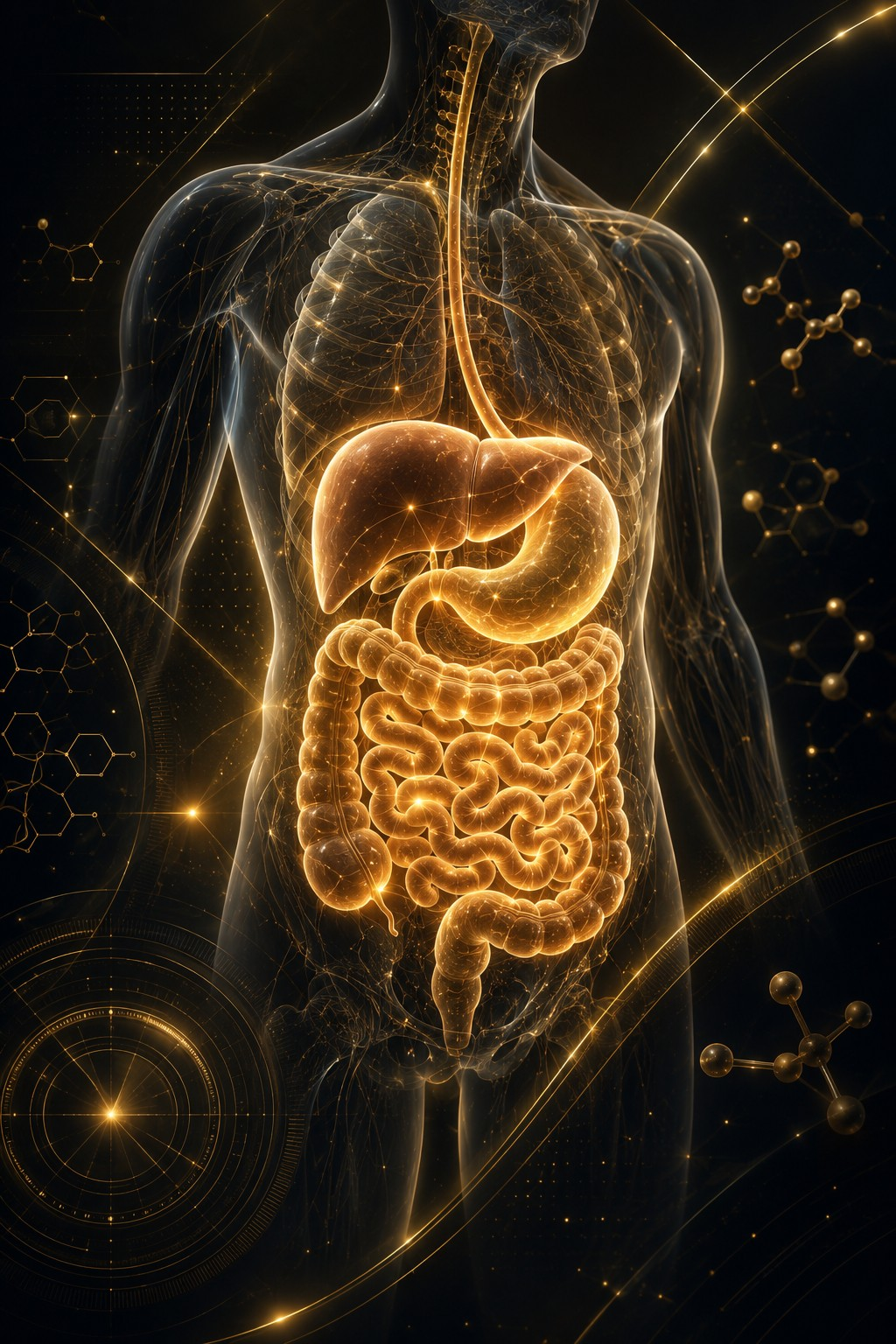
The Digestive System... The Key to Health in the Tayyibat Philosophy
The Digestive System... The Starting Point in the Journey to Health
When Dr. Diaa Al-Awadi speaks about health, he does not begin with the name of the disease or the organ where the symptoms appeared.
Instead, he directs attention to what he considers the foundation upon which all human health is built: the digestive system.
According to the Tayyibat philosophy, it is impossible to understand the causes of many health problems without understanding the role this system plays in receiving food, processing it, and converting it into the nutrients on which the body depends to perform its daily functions.
Dr. Diaa believes that many people view the digestive system as merely a means of digesting food, whereas it is, in fact, an integrated system that operates continuously, with functions that interact with most of the body's other systems.
Therefore, any dysfunction that repeatedly occurs within this system may gradually be reflected in overall health, even if its effects do not appear directly at first.
For this reason, he always emphasized, in essence, that the search for health begins with the digestive system, because everything that enters the body passes through it first.
This is why it occupies such a central position in the Tayyibat philosophy, as he considers it the starting point for understanding the relationship between food and human health.
This Is Where the Story Begins
Dr. Diaa explains that every day a person deals with dozens of inputs: foods, beverages, and various products.
These inputs do not become part of the body simply by being consumed. Rather, they first pass through a long journey within the digestive system, where the processes of digestion, absorption, and utilization of nutrients begin.
From this perspective, he believes that the quality of what reaches the body's cells is closely linked to the quality of what enters the digestive system and to the way it handles these inputs.
If foods are closer to their natural state and simpler in composition, then, according to his view, they are more consistent with the natural disposition upon which human beings were created.
However, when meals become filled with processed ingredients, additives, and substances that were never part of the human diet throughout history, the body, according to this perspective, is forced to make a greater effort to deal with them, which may, over time, affect its natural balance.
The Digestive System Is More Than Just the Stomach
One of the ideas that Dr. Diaa is keen to clarify is that the digestive system is not limited to the stomach alone, as many people believe.
Rather, it is a connected series of organs whose work begins the moment food is consumed and continues until the body has absorbed the nutrients and eliminated waste.
Therefore, any disturbance that occurs at one stage of this journey may affect the remaining stages, because the body functions as a single unit, not as separate organs working independently.
He also emphasizes that focusing on one organ while neglecting the rest of the system may cause a person to view the problem only partially, whereas, in his opinion, what is required is an understanding of the complete picture, because health is not built upon one part alone, but upon the integration of all vital functions.
Why Does the Digestive System Receive Such Importance?
According to Dr. Diaa's view, the reason is simple and clear: the body cannot build its cells, produce energy, or perform its various functions except through the nutrients it obtains from food after it passes through the digestive system.
Therefore, the quality of food cannot be separated from the quality of benefiting from it, just as eating more food does not necessarily mean obtaining more benefit.
In the Tayyibat philosophy, what matters is not the quantity of what enters the body, but the extent to which it is compatible with the body's nature and its ability to deal with it.
For this reason, he repeatedly stated in many of his explanations that:
"The problem is not food itself, but the type of food that people have become accustomed to eating every day."
From this point, he calls for reconsidering daily food choices because, according to his view, they represent the first step toward restoring balance before thinking about any other steps.
Natural Food... The Foundation of Balance
Dr. Diaa believes that the digestive system was created to deal with natural food. Therefore, he considers returning to simple, unprocessed foods to be one of the fundamental pillars of the Tayyibat philosophy.
The matter is not limited to choosing a specific type of food. Rather, it includes the entire way of thinking about food.
The closer food remains to its original form and the less it is exposed to processing and modification, the more compatible it is, in his view, with the body's natural needs.
For this reason, he does not present Tayyibat merely as a list of permitted and prohibited foods. Rather, he presents it as an invitation to rebuild the relationship with food, so that choices are based on natural disposition and simplicity, not on habit or the abundance of options imposed by the modern lifestyle.
The True Beginning of Health
Dr. Diaa concludes that caring for the digestive system is not an end in itself. Rather, it is the beginning of a broader journey toward restoring balance within the body.
Since all inputs pass through this system, caring for it, choosing the right food for it, and reducing what he considers to be burdensome factors represent, according to the Tayyibat philosophy, the first step toward building more stable health.
For this reason, he emphasizes that anyone who wants to understand the causes of many health problems should begin by asking about the nature of what enters the body every day, because, in Dr. Diaa Al-Awadi's view, the digestive system is not merely an organ of digestion, but the gateway through which health enters the human body.
How Does Dr. Diaa Al-Awadi Explain the Relationship Between the Digestive System and the Body's Health?
After explaining the central role of the digestive system in the human body, Dr. Diaa Al-Awadi moves on to an idea that he considers one of the most important foundations of the Tayyibat philosophy: that human health does not begin with medicine or with diagnosing disease.
Rather, it begins with the way the digestive system deals with what enters it every day.
From this perspective, he links the quality of digestion to the quality of health, believing that understanding this relationship helps explain many of the health problems that have become widespread in the modern era.
From Food to the Cell... A Journey That Never Stops
Dr. Diaa believes that food does not complete its role the moment it enters the stomach. Rather, at that point a complex journey begins through digestion and absorption, followed by the transfer of nutrients into the bloodstream and then to every cell in the body.
For this reason, he emphasizes that every cell in the body depends, directly or indirectly, on what the digestive system succeeds in extracting from food.
If the inputs are appropriate and digestion proceeds properly, the body's cells receive what they need to perform their natural functions.
However, if the inputs are not suitable for the body's nature, this, according to his view, is gradually reflected in the performance of the body's various systems.
From this perspective, he repeatedly emphasizes that the digestive system is not merely an organ that processes food, but the meeting point between food and the health of the entire human body.
Daily Inputs... The Factor That Never Stops
One of the most frequently used terms in Dr. Diaa's explanations is "inputs," by which he means everything that enters the body on a regular basis, whether food or drink.
He believes that the body deals with these inputs day after day without interruption. Therefore, their effect is not measured by a single meal or a single day, but by what is repeated continuously.
In his view, it is the daily habit that produces the long-term result.
For this reason, he places great emphasis on choosing foods that he considers closer to the natural human disposition and avoiding foods that he believes burden the digestive system and increase the strain placed upon it, because, according to his view, the body is affected more by what is repeated than by what happens only once.
Why Does He Emphasize Simplicity in Food?
One of the recurring principles in the Tayyibat philosophy is that the simpler the food, the easier it is to deal with.
For this reason, Dr. Diaa encourages reducing complexity within a single meal. He believes that a large number of ingredients, mixtures, and additives make digestion more difficult compared to simple meals based on clear and limited food items.
He does not present this idea as merely a formal rule, but rather as a way of reducing the burden on the digestive system and giving it a better opportunity to perform its function more efficiently.
This is consistent with the central idea of the Tayyibat philosophy: reducing what burdens the body and providing it with the conditions that help it function naturally.
Good Digestion... The Foundation of Balance
According to Dr. Diaa's view, it is not enough for food to be rich in nutrients; the body must also be capable of digesting and benefiting from it.
For this reason, he links good digestion with restoring balance, emphasizing that the problem may not lie in the quantity of food, but rather in the digestive system's ability to process it.
From this perspective, he focuses on choosing foods that he considers more compatible with the nature of the digestive system and believes that improving this stage is gradually reflected in the rest of the body's functions, because all organs ultimately depend on the nutrients they receive after digestion and absorption have been completed.
The Health of the Digestive System Is Not a Separate Goal
Dr. Diaa emphasizes that caring for the digestive system does not mean caring only for the stomach or the intestines. Rather, within the Tayyibat philosophy, it means caring for the foundation upon which all the body's other vital functions are built.
For this reason, he believes that any attempt to improve health should begin by reviewing the quality of food and daily habits, because they form the environment in which the digestive system operates every day.
If this environment improves, then, according to his view, the body becomes more capable of performing its functions and maintaining its balance.
For this reason, he often repeated, in essence, that:
"Correcting the inputs comes before correcting the results,"
because the body cannot function with its usual efficiency if the factors that burden it continue day after day.
In the Tayyibat philosophy, the digestive system is not viewed merely as the organ responsible for digesting food, but rather as the point from which the journey toward health begins.
Through it, all inputs pass, and through the efficiency of its function, nutrients reach the body's cells.
Therefore, Dr. Diaa Al-Awadi believes that paying attention to natural food, simplifying meals, and reducing the foods that he considers burdensome to the digestive system represent an essential step toward building a healthy balance that lasts over time.
When the Digestive System Becomes Imbalanced... How Does Dr. Diaa Explain the Beginning of Dysfunction in the Body?
After Dr. Diaa Al-Awadi explains that the digestive system represents the starting point in the journey toward health, he moves on to another idea that he considers complementary to this concept: that many health problems do not begin in the organ where symptoms appear, but rather when the digestive system loses its ability to deal with the daily inputs with the efficiency for which it was created.
According to the Tayyibat philosophy, this dysfunction does not occur suddenly. Instead, it develops gradually through the repeated dietary habits that he considers incompatible with human nature.
From Digestion Begins the Chain of Effects
Dr. Diaa believes that food does not become part of the body simply by being eaten. Rather, this depends on the quality of digestion and absorption.
Therefore, any disturbance at this stage may, according to his view, be reflected in the rest of the body's systems, because all the body's cells ultimately depend on the nutrients that pass through the digestive system.
For this reason, he emphasizes that caring for the digestive system is not intended merely to improve digestion, but to preserve the balance that the body's various organs need in order to perform their natural functions.
He explains that the body functions as one integrated unit. Therefore, dysfunction at the starting point may gradually extend its effects to other parts of the body over time.
Repetition Is More Dangerous Than an Occasional Mistake
One of the ideas that Dr. Diaa frequently repeats is that the problem does not lie in a single meal or an exceptional occasion, but rather in the habits that are repeated every day.
According to his view, a person does not burden the digestive system with one isolated mistake, but with a collection of practices that gradually become a way of life.
For this reason, he often explained, in essence, that the body possesses a remarkable ability to adapt, but it cannot continue carrying the same burden indefinitely.
When the inputs that he considers unsuitable continue, the body begins to show signs indicating that its balance is no longer what it once was.
Why Does He Link the Digestive System to Chronic Inflammation?
One of the fundamental concepts in the Tayyibat philosophy is the connection between the digestive system and what Dr. Diaa calls chronic inflammation.
He believes that the continued consumption of foods that he describes as burdensome to the digestive system may keep the body in a state of continuous stress, which, according to his view, is associated with the development of many health problems over time.
For this reason, he focuses on removing the causes that he believes keep the body in this condition, rather than concentrating only on the symptoms.
He repeatedly emphasizes that treating the results without reviewing the causes makes the problem likely to recur, because the factor that led to it is still present.
Simplicity Gives the Digestive System a Better Opportunity
Dr. Diaa also emphasizes that simplifying the meal is one of the important principles of the Tayyibat philosophy.
The greater the number of ingredients, the more complicated the task becomes for the digestive system.
In contrast, he believes that simple meals based on natural foods are more compatible with the way the body was created.
For this reason, he encourages avoiding excessive mixing of different foods within the same meal and relying on clear food choices with minimal processing, because, according to his view, this reduces the burden on the digestive system and gives it a better opportunity to function more efficiently.
Returning to the Starting Point
Dr. Diaa summarizes this idea by always returning to the fundamental question:
What enters the body every day?
In his view, maintaining the health of the digestive system begins by reviewing these daily inputs before searching for any other solutions.
Therefore, he calls for food to remain as close as possible to its natural form and for people to avoid the foods that he believes increase the burden on the digestive system, because "removing the cause is the first step toward restoring balance," an idea that appears repeatedly throughout his explanations.
According to this perspective, the digestive system becomes more than just an organ responsible for digestion. Rather, in the Tayyibat philosophy, it represents the foundation upon which human health is built and the place where the journey of maintaining or losing balance begins.
Toward a Balanced Digestive System... The Path Dr. Diaa Al-Awadi Presents for Maintaining Health
After explaining the importance of the digestive system and how the accumulation of inappropriate dietary habits can lead to its imbalance,
Dr. Diaa Al-Awadi arrives at the conclusion upon which the entire Tayyibat philosophy is based: maintaining the health of the digestive system is not achieved through temporary solutions, but begins with changing one's lifestyle from its roots.
He believes that a person does not need to search for a new way to repair the body every time. Rather, the first step is to stop the practices that continuously burden it. For this reason, he repeatedly says, in essence:
"The body knows how to perform its function if we do not burden it with what is not suitable for it."
From this point, the Tayyibat philosophy begins. Instead of chasing the results, it calls for removing the causes that he believes led to their appearance.
Returning to the Natural Disposition... The Foundation of Caring for the Digestive System
Dr. Diaa believes that the digestive system was created to deal with natural food. Therefore, the best thing that can be offered to it is food that remains close to the form in which God created it.
From this perspective, he calls for avoiding excessive consumption of processed foods and products that have undergone complex manufacturing processes, while relying, as much as possible, on simple foods that contain only a limited number of ingredients and additives.
He presents this idea not merely as a dietary rule, but as a return to the natural disposition, which he believes should form the foundation of people's daily food choices.
Listening to the Body's Signals
One of the principles that Dr. Diaa repeatedly emphasizes is that the body has its own language, expressed through natural signals such as hunger, thirst, and fullness.
For this reason, he stresses that one of the most important steps in maintaining digestive health is learning to listen to these signals.
A person should not eat out of habit, entertainment, or emotional stress, but only when experiencing true hunger, and should stop eating upon reaching fullness, without excess or overindulgence.
He believes that this natural relationship between a person and the body has weakened with the modern lifestyle.
Therefore, restoring it is, in his view, an essential part of the Tayyibat philosophy.
Simplicity Gives the Digestive System Greater Comfort
Dr. Diaa also emphasizes that a meal does not have to be complicated to be beneficial.
Rather, he believes that reducing the number of ingredients and choosing simple, clearly defined foods gives the digestive system a better opportunity to perform its function.
For this reason, he encourages avoiding excessive variety within a single meal, because simplicity, in his view, makes food more compatible with the body's nature and reduces the burden that heavily mixed meals may place on the digestive system.
Daily Habits Are What Produce the Results
One of the ideas most frequently emphasized in Dr. Diaa's explanations is that health is not built by a single decision made once, but by the habits that are repeated every day.
For this reason, he emphasizes that maintaining the digestive system does not depend on one meal or a short-term program, but on a continuous lifestyle in which a person chooses food consciously, practices moderation, and makes natural food the foundation of daily meals.
He believes that the results many people seek are not the product of one single step, but of hundreds of small decisions repeated over time.
The Digestive System... The Beginning, Not the End
In concluding this perspective, Dr. Diaa explains that caring for the digestive system does not mean focusing on one organ alone. Rather, it means caring for the entire system through which all the body's inputs pass.
For this reason, he considers improving digestive health to be the first step toward maintaining overall health, because, according to the Tayyibat philosophy, the body builds its various functions upon the nutrients it receives after digestion and absorption.
He concludes that the path toward better health begins with the simplest daily decisions: choosing natural food, listening to the body's signals, avoiding excess, and maintaining habits that are consistent with the natural human disposition.
These principles, as presented by Dr. Diaa Al-Awadi, are not temporary measures, but a way of life intended to allow the body to function within the environment for which it was created and to restore its natural balance whenever the burdens placed upon it are removed.